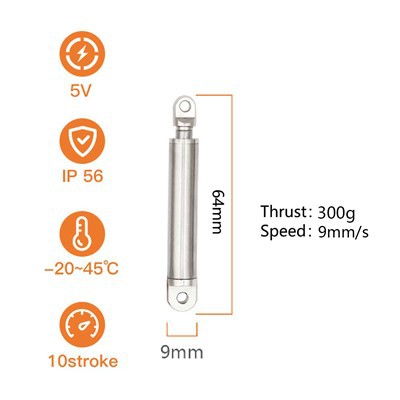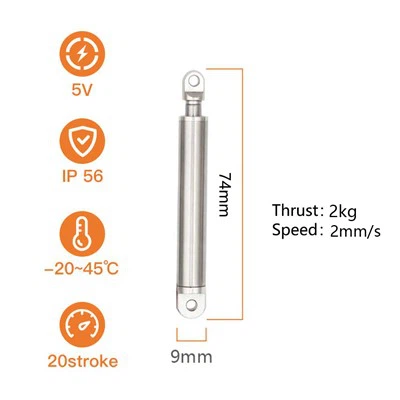
As a supplier of 12V Actuator Motors, I often receive inquiries from customers about various technical aspects of these motors. One frequently asked question is, "What is the winding resistance of a 12V actuator motor?" In this blog post, I will delve into this topic, explaining what winding resistance is, why it matters, how it is measured, and how it relates to the performance of a 12V actuator motor.
Understanding Winding Resistance
Winding resistance refers to the electrical resistance of the wire coils (windings) within an electric motor. In a 12V actuator motor, these windings are typically made of copper or aluminum wire. The resistance of a conductor is determined by its material, length, cross - sectional area, and temperature. According to Ohm's law (V = IR, where V is voltage, I is current, and R is resistance), the resistance affects the amount of current that flows through the windings when a voltage is applied.
The formula for calculating the resistance of a wire is given by (R=\rho\frac{l}{A}), where (\rho) is the resistivity of the material, (l) is the length of the wire, and (A) is the cross - sectional area of the wire. For copper, the resistivity (\rho) is approximately (1.72\times10^{-8}\Omega\cdot m) at room temperature, while for aluminum, it is about (2.82\times10^{-8}\Omega\cdot m).
Why Winding Resistance Matters
The winding resistance of a 12V actuator motor has several important implications for its performance:
Power Dissipation
When current flows through the windings, power is dissipated in the form of heat according to the formula (P = I^{2}R). A higher winding resistance means more power is lost as heat. Excessive heat can lead to a decrease in the motor's efficiency and may even damage the insulation of the windings over time, reducing the motor's lifespan.
Torque and Speed
The winding resistance also affects the motor's torque and speed characteristics. A motor with a lower winding resistance can draw more current for a given voltage, which generally results in higher torque output. However, this also means that the motor may draw more power and generate more heat. On the other hand, a motor with a higher winding resistance will draw less current, resulting in lower torque but potentially more stable speed control.
Compatibility with Power Supplies
The winding resistance determines the amount of current the motor will draw from a 12V power supply. If the resistance is too low, the motor may draw an excessive amount of current, which can overload the power supply or cause it to shut down. Conversely, if the resistance is too high, the motor may not receive enough current to operate properly.

Measuring Winding Resistance
Measuring the winding resistance of a 12V actuator motor is a relatively straightforward process, but it requires the use of a multimeter. Here are the steps:
- Turn off the Power: Before measuring the resistance, make sure the motor is disconnected from the power supply to avoid electrical shock.
- Set the Multimeter: Set the multimeter to the resistance (ohms) mode. Select an appropriate range based on the expected resistance of the motor. For most 12V actuator motors, a range of 0 - 100 ohms should be sufficient.
- Connect the Probes: Connect the two probes of the multimeter to the two terminals of the motor's windings. Make sure the connections are secure.
- Read the Measurement: The multimeter will display the resistance value. Take note of this value and compare it with the manufacturer's specifications. If the measured resistance is significantly different from the specified value, it may indicate a problem with the motor, such as a short - circuit or an open - circuit in the windings.
Typical Winding Resistance Values for 12V Actuator Motors
The winding resistance of a 12V actuator motor can vary widely depending on the motor's design, size, and application. Generally, small 12V actuator motors used in applications such as robotics or small appliances may have a winding resistance in the range of 10 - 50 ohms. Medium - sized motors used in automotive or industrial applications may have a resistance in the range of 5 - 20 ohms. Larger motors or those designed for high - torque applications may have even lower resistance values.
It's important to note that these are just rough estimates, and the actual winding resistance can vary depending on the specific motor model. When selecting a 12V actuator motor, it's always a good idea to refer to the manufacturer's datasheet for the exact resistance value.
Our 12V Actuator Motors
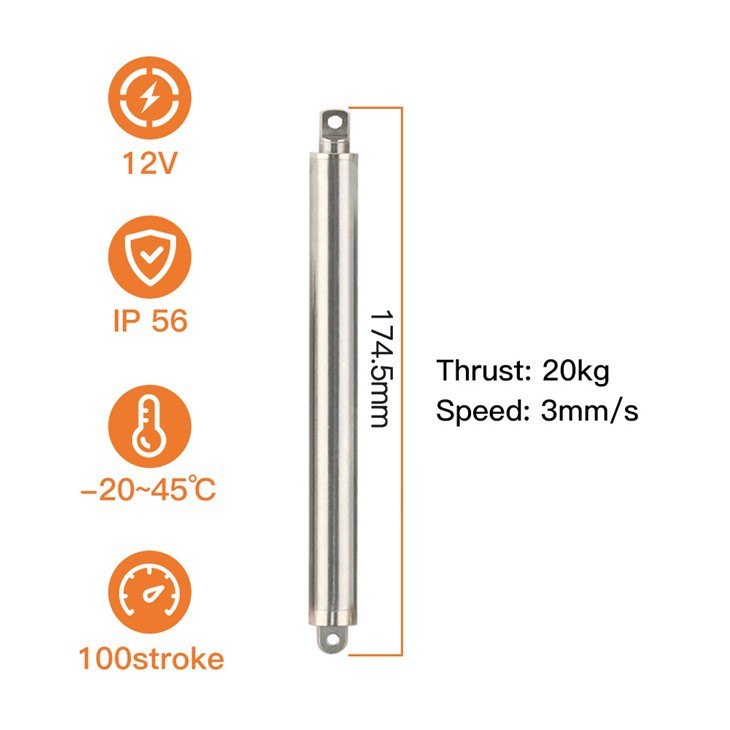
As a supplier of 12V Actuator Motor, we offer a wide range of high - quality motors with different winding resistance values to meet the diverse needs of our customers. Our motors are designed and manufactured to the highest standards, ensuring reliable performance and long service life.
In addition to our standard 12V actuator motors, we also offer Linear Motor 12V and 24V Actuator options for applications that require different voltage levels or linear motion capabilities. Our team of experts is always available to provide technical support and help you select the right motor for your specific application.
Conclusion
The winding resistance of a 12V actuator motor is an important parameter that affects its performance, efficiency, and compatibility with power supplies. By understanding what winding resistance is, why it matters, and how to measure it, you can make more informed decisions when selecting a motor for your application.
If you are interested in purchasing a 12V actuator motor or have any questions about our products, please feel free to contact us. We look forward to working with you and providing you with the best solutions for your motor needs.
References
- Electric Machinery Fundamentals, Stephen J. Chapman
- Motors and Drives: A Practical Technology Guide, Dominic A. Mellor