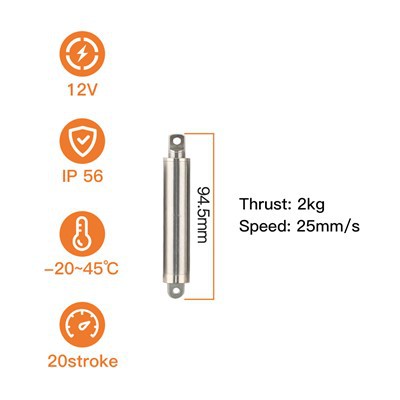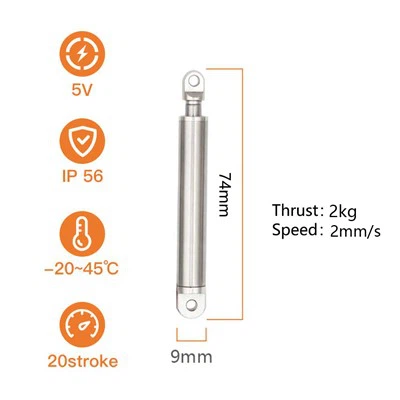
In the realm of modern engineering and automation, micro linear motors have emerged as crucial components, powering a wide array of applications from precision medical devices to high - tech consumer electronics. One of the fundamental electrical properties that significantly influences the performance of a micro linear motor is its inductance. As a supplier of [Micro Linear Motor], understanding and explaining the concept of inductance in these motors is essential for our customers to make informed decisions.
Understanding Inductance
Inductance, measured in henries (H), is a property of an electrical conductor or circuit that opposes a change in the electric current flowing through it. When an electric current passes through a coil of wire, a magnetic field is generated around the coil. The strength of this magnetic field is proportional to the current flowing through the coil. According to Faraday's law of electromagnetic induction, a change in the magnetic field induces an electromotive force (EMF) in the coil, which opposes the change in current. This opposition is what we refer to as inductance.
In a micro linear motor, the inductance plays a vital role in determining how the motor responds to changes in the applied voltage. A higher inductance means that the motor will have a slower response to changes in current, as it takes more time for the magnetic field to build up or collapse. Conversely, a lower inductance allows for a quicker change in current, enabling the motor to respond more rapidly to control signals.
Factors Affecting the Inductance of a Micro Linear Motor
Coil Design
The most significant factor influencing the inductance of a micro linear motor is the design of its coil. The number of turns in the coil has a direct impact on the inductance. As the number of turns increases, the magnetic field generated by the coil becomes stronger, and the inductance also increases. This is because each turn of the coil contributes to the overall magnetic field, and the induced EMF is proportional to the total magnetic flux linkage.
The cross - sectional area of the coil also affects inductance. A larger cross - sectional area allows for more magnetic flux to pass through the coil, resulting in a higher inductance. Additionally, the shape of the coil, such as whether it is a solenoid or a toroid, can influence the distribution of the magnetic field and, consequently, the inductance.
Core Material
The presence of a magnetic core inside the coil can significantly increase the inductance of a micro linear motor. A magnetic core, typically made of materials like iron or ferrite, has a high magnetic permeability. This means that it can enhance the magnetic field generated by the coil by providing a path of low reluctance for the magnetic flux. As a result, the magnetic flux density inside the coil increases, leading to a higher inductance.
However, the choice of core material also has implications for other motor characteristics. For example, some magnetic materials may introduce hysteresis losses, which can reduce the efficiency of the motor. Therefore, careful consideration must be given to the selection of the core material to balance the need for high inductance with other performance requirements.
Air Gap
In a micro linear motor, the air gap between the coil and the moving part (such as the plunger) also affects the inductance. A smaller air gap results in a higher inductance because the magnetic flux has to travel through a shorter distance of low - permeability air. Conversely, a larger air gap increases the reluctance of the magnetic circuit, reducing the magnetic flux and, thus, the inductance.
Impact of Inductance on Micro Linear Motor Performance
Speed of Response
As mentioned earlier, the inductance of a micro linear motor affects its speed of response. In applications where rapid acceleration and deceleration are required, such as in high - speed pick - and - place machines, a motor with low inductance is preferred. This allows the motor to quickly change its current and, consequently, its force output, enabling precise and rapid movements.
On the other hand, in applications where a smooth and stable motion is more important, such as in some medical imaging devices, a motor with higher inductance may be suitable. The higher inductance helps to filter out high - frequency fluctuations in the current, resulting in a more stable magnetic field and a smoother motion.
Power Consumption
Inductance also has an impact on the power consumption of a micro linear motor. When a motor with high inductance is energized, it takes more time for the current to reach its steady - state value. During this time, the motor draws more power from the power supply. Additionally, the energy stored in the magnetic field of an inductor is given by (E=\frac{1}{2}LI^{2}), where (L) is the inductance and (I) is the current. A higher inductance means that more energy is stored in the magnetic field, which can lead to increased power consumption, especially in applications where the motor is frequently turned on and off.
Torque and Force Output
The inductance of a micro linear motor can influence its torque and force output. The force generated by a linear motor is proportional to the current flowing through the coil and the magnetic field strength. Since inductance affects the current response of the motor, it indirectly affects the force output. A motor with appropriate inductance can be designed to provide the desired force characteristics for a specific application.
Selecting the Right Micro Linear Motor Based on Inductance
When choosing a micro linear motor for a particular application, it is crucial to consider the inductance requirements. For applications that demand high - speed operation and quick response times, motors with low inductance, such as those with fewer turns and minimal magnetic core, are more suitable. These Linear Micro Actuators can be found in our product range, offering excellent performance in dynamic applications.
For applications that prioritize smooth motion and stable force output, motors with higher inductance may be the better choice. Our Micro Linear Motor series includes models with optimized inductance for such applications, ensuring reliable and precise operation.
If you are working on a project that requires a specific voltage, our Micro Linear Actuator 6V offers a great option. These actuators are designed with careful consideration of inductance to provide the best performance at 6V.
Conclusion
The inductance of a micro linear motor is a critical parameter that significantly impacts its performance. By understanding the factors that affect inductance and its implications for motor operation, customers can make more informed decisions when selecting a micro linear motor for their applications. As a supplier, we are committed to providing high - quality micro linear motors with carefully engineered inductance characteristics to meet the diverse needs of our customers.
If you are interested in learning more about our micro linear motors or would like to discuss your specific requirements, we encourage you to contact us. Our team of experts is ready to assist you in choosing the right motor for your project and to support you throughout the procurement process. Whether you need a motor for a high - speed automation task or a precision medical device, we have the solutions you need.


References
- Fitzgerald, A. E., Kingsley, C., & Umans, S. D. (2003). Electric Machinery. McGraw - Hill.
- Chapman, S. J. (2012). Electric Machinery Fundamentals. McGraw - Hill.
- Kraus, J. D., & Carver, K. R. (1988). Electromagnetics. McGraw - Hill.