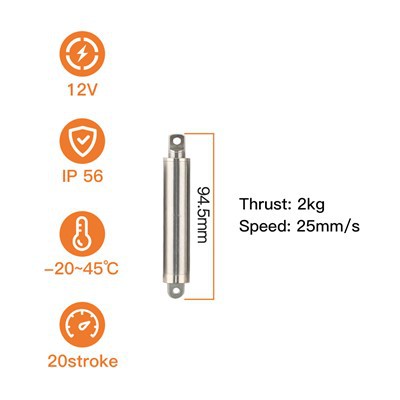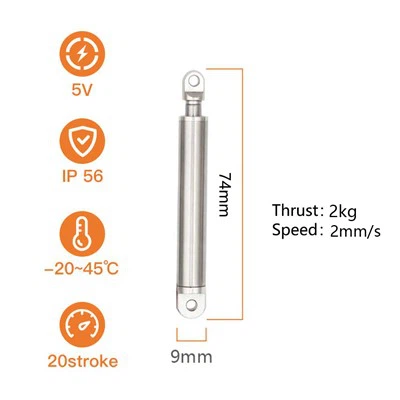
Hey there! As a supplier of Electric Actuator 6V, I often get asked a bunch of questions from customers. One question that pops up quite a bit is, "Can a 6V electric actuator be used in a vacuum environment?" Well, let's dig into this topic and find out.
First off, let's understand what a 6V electric actuator is. An Electric Motor Linear Actuator is a device that converts electrical energy into linear motion. The 6V version runs on a 6 - volt power supply, which is relatively low - voltage. It's commonly used in various applications where precise linear movement is needed, like in small robotics, automation systems, and some consumer electronics.
Now, when it comes to using it in a vacuum environment, there are several factors we need to consider.
1. Lubrication and Sealing
In a normal environment, the moving parts of an electric actuator are usually lubricated to reduce friction and wear. However, in a vacuum, traditional lubricants can outgas. Outgassing is when the lubricant releases gases due to the low - pressure environment. These gases can contaminate the vacuum chamber and might also damage other sensitive equipment inside.
Some Electric Actuator 6V models are designed with special vacuum - compatible lubricants. These lubricants have very low outgassing rates, making them suitable for use in a vacuum. Sealing is also crucial. The actuator needs to be well - sealed to prevent any air or contaminants from entering the vacuum chamber. If the sealing is not good, it can disrupt the vacuum and affect the performance of other components.
2. Electrical Insulation
In a vacuum, the electrical insulation properties of materials can change. The lack of air, which normally acts as a dielectric in some cases, can lead to issues like arcing. Arcing occurs when there is a breakdown of the electrical insulation, and an electric current jumps across a gap.
Our Electric Linear Actuator 6V is designed with high - quality electrical insulation materials that are tested to work in a vacuum. These materials maintain their insulating properties even in the low - pressure environment, reducing the risk of arcing and ensuring the safe operation of the actuator.
3. Thermal Management
Heat dissipation is another challenge in a vacuum. In a normal atmosphere, heat can be transferred through convection (the movement of air). But in a vacuum, there is no air to carry away the heat, so the actuator can overheat more easily.


To deal with this, our 6V electric actuators are equipped with efficient heat - sinking mechanisms. These heat sinks are designed to conduct heat away from the actuator's critical components and radiate it into the surrounding environment. This helps to keep the actuator at a safe operating temperature, even in a vacuum.
4. Material Compatibility
The materials used in the construction of the actuator need to be compatible with the vacuum environment. Some materials can react with the residual gases in the vacuum or change their properties under low - pressure conditions.
We use carefully selected materials in our 6V electric actuators. These materials are resistant to corrosion, have low outgassing rates, and maintain their mechanical properties in a vacuum. This ensures the long - term reliability and performance of the actuator in a vacuum environment.
Real - World Applications
There are actually quite a few real - world applications where 6V electric actuators are used in vacuum environments. For example, in some space - related experiments, small 6V actuators are used to control the movement of sensors or small instruments inside a vacuum chamber. In semiconductor manufacturing, where a clean and controlled vacuum environment is essential, 6V actuators can be used for precise positioning of wafers or other components.
Conclusion
So, to answer the question, yes, a 6V electric actuator can be used in a vacuum environment, but it has to be designed and built with the specific challenges of a vacuum in mind. Our company has been in the business of supplying high - quality Electric Actuator 6V for years, and we've put a lot of effort into making sure our actuators can perform well in a vacuum.
If you're in the market for a 6V electric actuator for a vacuum application, don't hesitate to reach out. We're here to provide you with the right product and answer any questions you might have. Whether you're working on a small - scale experiment or a large - scale industrial project, our 6V electric actuators can meet your needs. Contact us today to start the procurement process and let's discuss how we can work together to make your project a success.
References
- "Vacuum Technology Handbook" by O'Hanlon, J. F.
- "Electrical Insulation in Extreme Environments" - various research papers from IEEE Electrical Insulation Society.
- In - house research and development reports on 6V electric actuator design for vacuum applications.