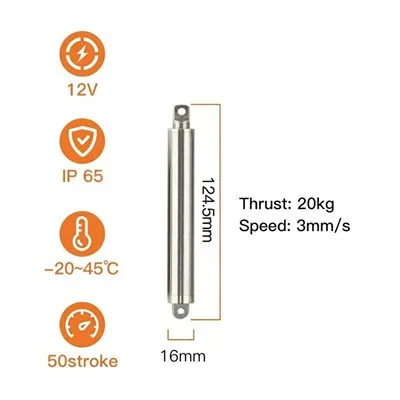
The working principle of DIY linear actuators is mainly based on the basic principle of converting rotational motion into linear motion. Linear actuators drive transmission devices through motors to achieve linear motion of objects. The following are the main components and working principles of DIY linear actuators:
Main components:
Motor: Common ones include DC motors, AC motors, and stepper motors, which provide power for the actuator.
Transmission device: Including lead screws, gear racks, belt drives, etc., which convert the rotational motion of the motor into linear motion.
Guide devices: Such as guide rails and sliders, ensure that the movement direction of the actuator is accurate and stable, and reduce shaking and deviation during movement.
Working principle:
Take the linear actuator with a motor-driven lead screw as an example. When the motor rotates, the lead screw is driven to rotate through connecting devices such as couplings. The nut on the lead screw cannot rotate due to the restriction of the guide rail and can only move along the axial direction of the lead screw. In this way, the rotational motion of the motor is converted into the linear motion of the nut.
By controlling the forward and reverse rotation and speed of the motor, the actuator can move forward, backward, and at different speeds.