Electric linear actuators, mechatronic components that convert electrical energy into linear reciprocating motion, are finding widespread application in the model industry (including static display models, dynamic functional models, and remote-controlled models) thanks to their low-noise operation and compact design. They address the pain points of traditional models, such as reliance on manual adjustment and the bulkiness of pneumatic/hydraulic systems, providing a key driver for the automation and intelligent upgrade of models.
I. Core Advantages of Electric Linear Actuators in Model Applications
In model applications, the characteristics of electric linear actuators are highly compatible with demand, primarily embodied in the following four key areas:
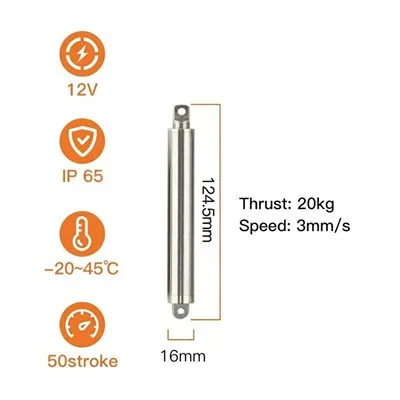
Size Adaptability: Electric linear actuators are available on the market with travels ranging from a few centimeters to tens of centimeters (e.g., diameters of 8-16mm and lengths of 10-120mm). These actuators can be directly embedded within small models, such as car models, mecha models, and architectural sandboxes, eliminating the need for extensive installation space. Convenient and stable operation: Supporting DC power supply (common 6V/12V/24V), it can be directly controlled by a remote control, microcontroller (such as Arduino), or PLC, eliminating the need for complex air/oil circuit maintenance. Furthermore, most electric linear actuators have a self-locking function (maintaining their current position after power failure), preventing model components from shifting due to gravity or external forces.
Low noise and long life: Electric linear actuators, using a trapezoidal lead screw drive, typically produce operating noise below 50 decibels (similar to a quiet conversation indoors), ensuring a pleasant display/operation experience. High-quality products can last for over 10,000 reciprocating cycles, ensuring long-term model use.
II. Specific Application Scenarios by Model Type
Different models have significantly different functional requirements for Electric Linear Actuators. The following are detailed application scenarios for four major scenarios:
1. Remote Control Models (RC Models)
Car Models: Used for opening and closing scissor doors and gull-wing doors (e.g., a 1:10 scale RC sports car equipped with a micro ELA with a 10mm travel), raising and lowering the chassis (using two symmetrically connected ELAs to achieve 5-20mm height adjustment). Some high-end models also use Electric Linear Actuators to simulate transmission shifting, switching between gear positions based on travel.
Aircraft/Helicopter Models: In fixed-wing models larger than 1:20 scale, ELAs can replace traditional servos to control flap and aileron angles (particularly suitable for large models, as they offer greater load capacity than servos). Landing gear retraction and extension on helicopter models can also be achieved with ELAs, eliminating the risk of air leaks in the pneumatic system. Ship Models: Used for "rudder steering control" and "anchor windlass raising and lowering" (a small ELA combined with a steel wire rope enables automatic retraction and extension of the anchor chain), especially suitable for recreating detailed warship models.
2. Static Simulation Models
Architectural Sandbox Models: In real estate or urban planning sandboxes, the Electric Linear Actuator can achieve "layered building lighting" (moving a sunshade through travel to gradually reveal the LED light cluster), "road gate raising and lowering" (a miniature ELA controls the gate lever to rotate 90°), and "subway/elevator simulation" (the ELA drives the elevator car up and down along the track, with an adjustable speed of 0.5-2 mm/s). Industrial machinery models: For example, a 1:15 scale "robotic arm model" uses 3-5 electric linear actuators to control the extension and rotation of the arm, forearm, and wrist, simulating the grasping and handling movements of a real robotic arm. In the "production line model," ELAs can push the "blockers" and "sorting baffles" on the conveyor belt to achieve automated material diversion.
Historical scene models: In the museum's "ancient city gate model" and "steam train model," electric linear actuators can be hidden within the structure, enabling automatic opening and closing of the gate and raising and lowering of train valves through timed control, enhancing the interactive feel of the scene.
III. Key Points for Selecting and Installing Electric Linear Actuators for Models
1. Key Parameter Selection Recommendations
Load Capacity: Select based on the weight of the model components. For small models (such as RC car doors), choose a load of 5-20N; for medium-sized models (such as building elevators), choose 20-50N; and for large models (such as 1:10 robotic arms), choose 50-200N.
Stroke Length: Calculate the required distance + 5mm of allowance. For example, if a model door requires an 8mm opening and closing, choose an ELA with a 10mm stroke to avoid insufficient stroke and component jamming.
Speed: For static models, choose 2-5mm/s (such as building elevators); for dynamic models, choose 5-20mm/s (such as RC car doors) to avoid excessive speed and component collision.
Control Mode: For simple scenarios, choose "on-off control" (using relays for extension and retraction); for complex scenarios, choose "PWM speed control" (using a microcontroller for precise speed and position adjustment). 2. Installation and Commissioning Notes
Securing Method: Small electric linear actuators can be secured to a model plastic or metal bracket using hot melt adhesive or screws. Ensure the mounting surface is flat (to avoid uneven force and noise during operation). When the load is large, it is recommended to install "fisheye bearings" at both ends of the electric linear actuator to reduce the impact of radial force on life.
Commissioning Tips: During initial operation, manually test the electric linear actuator's maximum extension and retraction stroke and mark the "limit positions" (to avoid overload damage). Gradually adjust the speed using the controller to observe whether the components move smoothly.
IV. Application Trends and Future Directions
With the advancement of micromotor and 3D printing technologies, the application of electric linear actuators in modeling will become increasingly miniaturized and customized. For example, custom ELA mounting brackets can be 3D printed for specific models (such as 1:8 scale mecha models), enabling seamless integration. Furthermore, electric linear actuators with position feedback functions (such as built-in potentiometers or encoders) will become increasingly common, enabling real-time monitoring of the position of model components and providing data support for fully automated models (such as autonomous obstacle avoidance for unmanned boat models).
Furthermore, the integration of electric linear actuators with IoT technology will become a new development. For example, in historical modeling models in museums, visitors can send commands by scanning a QR code on their mobile phones, controlling the electric linear actuator to drive the model's movements (such as opening an ancient city gate), further enhancing the interactive experience.