Miniaturization Trends in Medical Devices: Application Advantages of Micro Linear Actuators in Pulse Syringes
With the rapid growth of the portable medical device market, the requirements for integration density of internal precision transmission components have become increasingly stringent. As a core component in biopharmaceutical testing and clinical drug delivery, the power source for pulse syringes must provide reliable thrust within extremely confined cavities.
Solving the Challenge of Narrow-Space Integration:
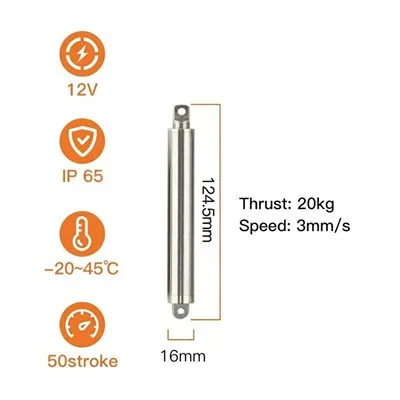
Traditional motor-and-leadscrew mechanisms are often too bulky, limiting the miniaturization of medical devices. Micro linear actuators utilize a highly integrated tubular structure, encapsulating the motor and leadscrew within a minimal diameter shell. This design allows R&D personnel to deploy the power source directly within the limited space of a pulse syringe, eliminating the need for complex reduction gears and transmission converters.
Technical Adaptation for Specific Operating Conditions:
Based on the fact that this series of products currently lacks precise position feedback, its application in pulse syringes is primarily focused on fixed-stroke injection tasks. Under conditions where stroke limits are pre-set, the actuator can accurately complete "Start-Inject-Reset" cycles. By utilizing mechanical limits or overcurrent protection for position control, the complexity and hardware costs of the control system are significantly reduced.
Meeting Medical Environment Standards:
Silent Operation: Noise levels are controlled around 50dB to 60dB , meeting the quiet environment requirements of operating rooms or laboratories.
Protection Level: Featuring an IP65 rating, it effectively resists liquid splashes or disinfectant wiping common in medical settings.
Intermittent Drive: Pulse syringes typically operate on a trigger basis rather than continuous high-frequency movement. This aligns perfectly with the intermittent duty cycle of micro actuators, preventing heat-related wear.
Industry Outlook: Simplification and high reliability are the core development goals for medical device components. By eliminating unnecessary costs associated with closed-loop feedback, micro linear actuators-through extreme size control and performance stability-provide a cost-effective drive solution for biopharmaceutical testing, rehabilitation aids, and automated pharmaceutical cabinets.
FAQ: Common Technical Questions
Q1: Can this actuator achieve high-precision real-time flow adjustment during pulse injection?
A: Currently, this series of actuators does not have position feedback (such as Hall sensors or potentiometers). Therefore, it cannot achieve millimeter-level closed-loop micro-adjustment without external sensors. It is best suited for fixed-stroke injections. For fine flow control, it is recommended to add external pressure sensors or choose models with feedback capabilities.
Q2: Does the product support low-voltage power systems for medical devices?
A: Yes. The products are available in 5V, 12V, and 24V DC specifications. For portable, battery-powered medical devices, the 5V version is directly compatible with standard lithium battery packs or control boards.
Q3: Why is it not recommended for high-frequency, 24/7 repetitive medical production lines?
A: Micro actuators are designed primarily for intermittent load scenarios. Under high-frequency conditions (e.g., multiple reciprocations per second) and long-term continuous operation, the heat generated by the micro motor may not dissipate in time, affecting its lifespan. It is most stable in tasks like pulse syringes where there are intermittent pauses after a single trigger.