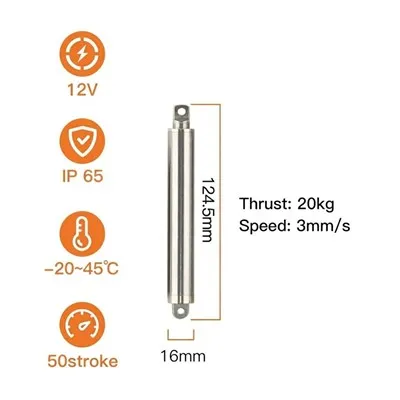
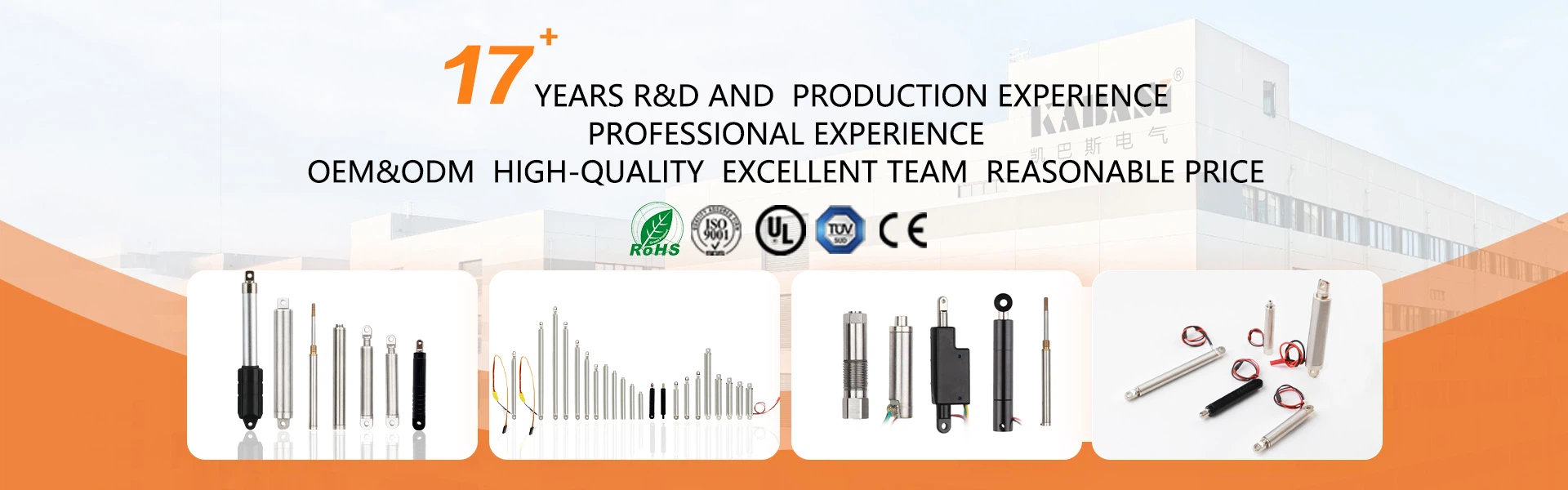
Linear actuators serve as the core power execution units of humanoid robots. Their technical performance directly determines the robots' motion precision, load capacity, endurance performance, and safety reliability. As the key underlying technology enabling human - like flexible movements, linear actuators hold irreplaceable strategic significance for the commercialization and application - scenario expansion of humanoid robots.
I. Core Functional Positioning: The "Muscle - Driven System" of Humanoid Robots
The human - like motion capability of humanoid robots relies on the coordinated control of multiple joints. Linear actuators take on the core driving function similar to that of human skeletal muscles, which is specifically reflected in three major aspects:
Core of Joint Power Output: A humanoid robot has 20 to 40 degrees - of - freedom joints across its body (such as head pitching, shoulder joint flexion and extension, and hip joint rotation). Each high - load joint requires a linear actuator to provide precise linear driving force for joint angle adjustment and posture maintenance. For instance, the linear actuator at the leg's knee joint needs to support the robot's body weight to perform dynamic actions like walking and turning. Its thrust performance directly determines the robot's load - bearing upper limit (usually required to cover 80 - 150kg of body weight plus dynamic loads).
Foundation of Motion Precision Control: Equipped with built - in encoders and servo systems, linear actuators can achieve displacement precision at the 0.01mm level and angle control at the 0.1° level, providing humanoid robots with smooth and accurate motion trajectories. This feature is the technical prerequisite for completing precise operations (such as grabbing objects and assembling parts) and natural - gait walking, preventing jamming or overshoot issues during movement.
Hub of System Integration: Integrating motors, reducers, transmission mechanisms, sensors, and controllers, linear actuators can be embedded into the robot's joint design as modular units, which greatly simplifies the R&D process and enhances system stability. Take Kabas Electric's servo linear actuators as an example. Their integrated design can directly adapt to the joint interfaces of mainstream robots, shortening the integration cycle by more than 50%.
II. The Decisive Impact of Key Performance Indicators on Robots
| Performance Indicator | Technical Parameter Requirements | Impact on Humanoid Robots |
|---|---|---|
| Thrust/Power Density | Thrust ranging from 500N to 5000N, power density ≥ 2.5kW/kg | Determines the robot's load capacity (e.g., walking with a load and carrying objects) and motion flexibility. A high - density design can reduce the robot's body weight. |
| Response Speed | No - load response time ≤ 0.2s, closed - loop control frequency ≥ 1kHz | Affects the dynamic balance capability (e.g., posture adjustment while walking) and emergency response speed, serving as the foundation for rapid motion switching. |
| Positioning Accuracy | Repeat positioning accuracy ≤ ± 0.05mm, absolute accuracy ≤ ± 0.1mm | Directly related to the precision operation capability (e.g., grabbing small parts) and gait stability. Insufficient accuracy will lead to motion deviations. |
| Endurance Efficiency | Energy conversion efficiency ≥ 85%, standby power consumption ≤ 1W | Determines the battery life (commercial robots require ≥ 4 hours of continuous operation). A high - efficiency design can reduce energy consumption. |
| Protection Class | IP54 and above (IP65 for joint parts) | Ensures adaptability to complex scenarios (e.g., outdoor walking and industrial field operations) and prevents dust and water stains from affecting operational stability. |
Among these indicators, power density and response speed are particularly crucial. Humanoid robots need to achieve high - intensity movements with a lightweight body. Kabas Electric's brushless servo linear actuators, by optimizing the transmission structure, have increased the power density to 3.2kW/kg, which can meet the dynamic movement requirements of bipedal robots such as running and jumping.
III. Differentiated Needs of Application Scenarios and Actuator Technology Adaptation
Industrial Collaboration Scenarios: Tasks such as heavy - load handling and precision assembly require linear actuators to have the characteristics of high thrust (≥ 3000N) and strong impact resistance. Kabas' heavy - duty actuators adopt planetary gear reducers, which can withstand instantaneous impacts of 1.5 times the rated load, making them suitable for industrial scenarios like automobile manufacturing and electronic processing.
Service/Home Scenarios: Emphasis is placed on safety and mute effect. The actuators need to be low - noise (≤ 50dB) and equipped with collision detection functions. The current monitoring technology realizes safety protection with a collision force ≤ 50N, avoiding injuries during human - robot interaction. Meanwhile, the mute design improves the user experience.
Special - Operations Scenarios (such as fire fighting and rescue): There are extremely high requirements for environmental adaptability. The actuators need to have a wide temperature range (- 40℃ ~ + 85℃) and explosion - proof performance. Kabas' military - grade actuators can operate stably in extreme environments through special sealing processes.
Scientific Research and Education Scenarios: Openness and customizability are emphasized. The actuators need to support multi - protocol communication (EtherCAT, Modbus) and parameter programmability, facilitating scientific research teams to conduct algorithm debugging and motion optimization.
IV. Directions of Technological Innovation and Development Trends of Humanoid Robots
Lightweight and Integration: The use of carbon fiber materials and integrated design reduces the weight of the actuator by more than 30%. At the same time, functions such as torque sensors and temperature monitoring are integrated to improve the intelligence level. Kabas Electric has launched a 2000N thrust actuator weighing only 1.2kg, which meets the lightweight requirements of humanoid robots.
Intelligent Servo Control: The combination of AI algorithms realizes adaptive control. The actuator can adjust the output parameters in real - time according to the load changes. For example, it can automatically optimize the joint thrust distribution while walking, reducing energy consumption by 30%.
Flexible Driving Technology: The development of flexible linear actuators with force - feedback functions simulates the elastic characteristics of human muscles, improving the safety of human - robot interaction. Kabas' flexible servo actuators can achieve 0-100% force output adjustment, which are widely used in the field of medical rehabilitation robots.
Wireless and Thermal Management Optimization: The adoption of wireless power supply and efficient heat dissipation design solves the problems of complex joint wiring and overheating during long - term operation, providing technical support for full - body flexible robots.
V. The Strategic Value of Technological Breakthroughs in Linear Actuators for the Industry
Lowering the Threshold for Commercialization: Modular and standardized linear actuators (such as Kabas' robot - specific series) can significantly reduce R&D costs, enabling small and medium - sized manufacturers to enter the humanoid robot field and accelerating the expansion of the industrial ecosystem.
Driving Leapfrog Improvements in Performance: The breakthrough in power density and the improvement in response speed of the new - generation actuators make it possible for humanoid robots to achieve advanced functions such as running (speed ≥ 5km/h) and load - bearing (≥ 50kg), expanding the application boundaries.
Ensuring Safety and Reliability: Through closed - loop control and safety monitoring technology, linear actuators can realize fault self - diagnosis and emergency braking, solving the core safety pain points in the commercialization of humanoid robots.
VI. Summary and Selection Suggestions
As the "power heart" of humanoid robots, the technical level of linear actuators directly determines the robots' motion capabilities, application scenarios, and market competitiveness. When selecting a model, three core factors should be focused on: the matching degree of thrust and power density, whether the response speed meets the dynamic requirements, and whether the protection class is suitable for the use environment.
For R&D teams pursuing high performance, it is advisable to give priority to products with servo control and integrated design - such as Kabas Electric's KBS - S series actuators. Integrated with absolute encoders and bus communication functions, they can be directly connected to the robot control system, greatly improving the development efficiency. As the humanoid robot industry enters a period of explosive growth, linear actuator technology will continue to iterate, serving as the core driving force to promote the industry from the laboratory to commercialization.