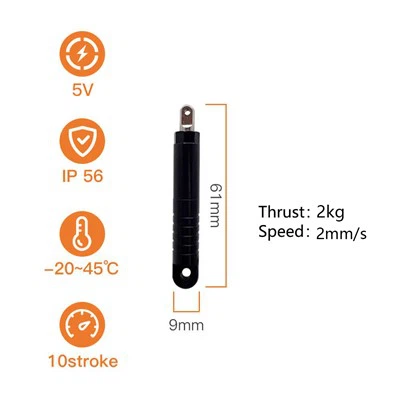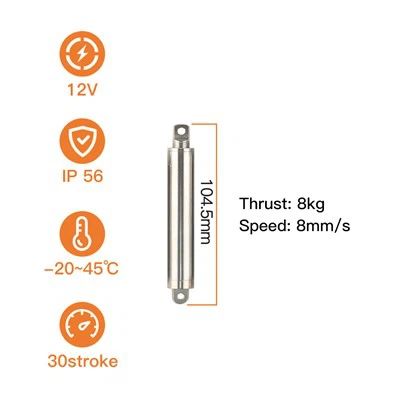
Hey there! As a supplier of Tiny Linear Actuators, I often get asked about the dynamic load capacity of these nifty little devices. So, let's dive right in and break it down.
First off, what exactly is a Tiny Linear Actuator? Well, it's a compact device that converts rotational motion into linear motion. You can think of it as a mini - powerhouse that can move things in a straight line. If you're curious to learn more about them, check out our Tiny Linear Actuator page.
Now, onto the main topic: dynamic load capacity. The dynamic load capacity of a Tiny Linear Actuator refers to the maximum load that the actuator can handle while it's in motion. This is different from the static load capacity, which is the maximum load the actuator can support when it's not moving.
Why is dynamic load capacity important? Imagine you're using a Tiny Linear Actuator in a robotic arm. The arm needs to move objects around, and the actuator has to be able to handle the weight of those objects while in motion. If the load exceeds the dynamic load capacity, the actuator might not work properly. It could overheat, wear out faster, or even break down completely.
Several factors affect the dynamic load capacity of a Tiny Linear Actuator. One of the key factors is the speed of operation. Generally, as the speed of the actuator increases, its dynamic load capacity decreases. This is because higher speeds put more stress on the internal components of the actuator. For example, if you have an actuator that can handle a 10 - pound load at a slow speed, it might only be able to handle 5 pounds at a much higher speed.
Another factor is the type of motion. If the actuator is moving in a smooth, continuous motion, it can usually handle a higher load compared to a jerky or intermittent motion. Jerky motions create sudden spikes in stress on the actuator, which can reduce its effective dynamic load capacity.
The quality of the materials used in the actuator also plays a big role. Actuators made from high - quality materials are often able to handle higher dynamic loads. For instance, an actuator with a strong, durable motor and a well - designed gear system will be more capable of handling heavy loads while in motion.


Let's talk about how to calculate the dynamic load capacity. Unfortunately, there's no one - size - fits - all formula. It usually depends on the specific design and specifications of the actuator. Most manufacturers, including us, provide detailed technical data sheets that give information about the dynamic load capacity under different conditions. These data sheets take into account factors like speed, acceleration, and the type of load (e.g., constant load, variable load).
If you're in a situation where you need to use a Tiny Linear Actuator for a specific application, it's crucial to choose one with the right dynamic load capacity. For example, if you're building a small automated conveyor system, you need to know the weight of the items that will be moving on the conveyor and the speed at which they'll be moving. Then, you can select an actuator that can handle that load and speed combination.
Now, let's compare Tiny Linear Actuators with other types of actuators in terms of dynamic load capacity. Linear Motor Actuators are known for their high - speed and high - precision capabilities. They often have a relatively high dynamic load capacity, especially when it comes to handling light to medium loads at high speeds. However, they can be more expensive and complex compared to Tiny Linear Actuators.
On the other hand, Electric Lift Cylinders are designed mainly for lifting heavy loads. They usually have a high static load capacity, but their dynamic load capacity might be more limited when it comes to fast - paced, continuous motion.
When it comes to applications, Tiny Linear Actuators are used in a wide range of industries. In the medical field, they're used in devices like adjustable hospital beds and dental chairs. These applications require precise movement and the ability to handle a certain amount of load while in motion. In the automotive industry, they can be found in things like power windows and seat adjusters.
If you're still not sure which Tiny Linear Actuator is right for your application in terms of dynamic load capacity, don't worry. Our team of experts is here to help. We can analyze your specific requirements, take into account all the factors we've discussed, and recommend the best actuator for you.
Whether you're a hobbyist working on a DIY project or a professional engineer designing a complex industrial system, getting the dynamic load capacity right is essential for the success of your project.
So, if you're interested in purchasing Tiny Linear Actuators and want to discuss the dynamic load capacity for your specific needs, feel free to reach out. We're always happy to have a chat and help you find the perfect solution.
In conclusion, understanding the dynamic load capacity of a Tiny Linear Actuator is crucial for anyone looking to use these devices. By considering the factors that affect it, choosing the right actuator, and getting the necessary support, you can ensure that your actuator performs well and lasts a long time.
References
- Industry - standard technical manuals on linear actuators
- In - house research and development data from our company's experience with Tiny Linear Actuators