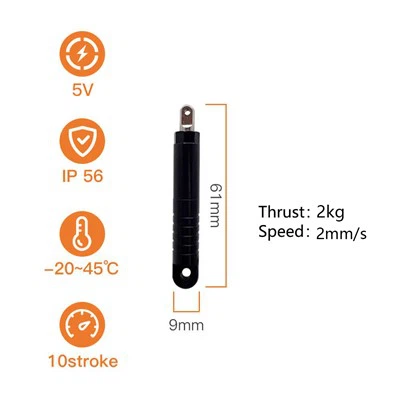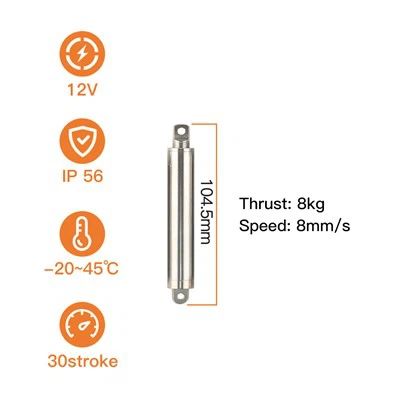
As a supplier of Linear Motor Actuators, I've witnessed firsthand the critical role that static stiffness plays in determining the performance of these remarkable devices. In this blog post, I'll delve into the relationship between static stiffness and the performance of linear motor actuators, exploring how this fundamental property influences various aspects of their operation.
Understanding Static Stiffness in Linear Motor Actuators
Before we explore the impact of static stiffness on performance, let's first understand what static stiffness means in the context of linear motor actuators. Static stiffness refers to the ability of an actuator to resist deformation under a static load. It is typically measured as the ratio of the applied force to the resulting displacement, expressed in units of force per unit length (e.g., N/mm).
In a linear motor actuator, static stiffness is influenced by several factors, including the design of the motor, the materials used in its construction, and the mechanical components that support the moving parts. A high static stiffness indicates that the actuator can maintain its position accurately under load, while a low static stiffness may result in significant displacement or deflection, leading to reduced performance and accuracy.
Impact on Positioning Accuracy
One of the most significant ways in which static stiffness affects the performance of linear motor actuators is in terms of positioning accuracy. In applications where precise positioning is critical, such as semiconductor manufacturing, precision machining, and metrology, even small deviations from the desired position can have a significant impact on the quality of the final product.
A linear motor actuator with high static stiffness can maintain its position more accurately under load, minimizing the effects of external forces and disturbances. This is because the actuator's high stiffness allows it to resist deformation and deflection, ensuring that the moving parts remain in the desired position. On the other hand, an actuator with low static stiffness may experience significant displacement or deflection under load, leading to errors in positioning and reduced accuracy.
For example, in a semiconductor manufacturing process, a linear motor actuator may be used to position a wafer precisely during the lithography step. If the actuator has low static stiffness, it may deflect under the weight of the wafer or the forces exerted by the lithography equipment, resulting in misalignment and defects in the semiconductor chips. In contrast, an actuator with high static stiffness can maintain the wafer's position accurately, ensuring high-quality chip production.
Influence on Repeatability
In addition to positioning accuracy, static stiffness also plays a crucial role in determining the repeatability of linear motor actuators. Repeatability refers to the ability of an actuator to return to the same position repeatedly, within a specified tolerance. In applications where the same motion needs to be repeated multiple times, such as pick-and-place operations in robotics or automated assembly lines, high repeatability is essential for ensuring consistent performance and product quality.
A linear motor actuator with high static stiffness can achieve better repeatability because it is less prone to deformation and deflection under load. This means that the actuator can return to the same position more accurately, even after multiple cycles of operation. On the other hand, an actuator with low static stiffness may experience variations in its position due to the effects of external forces and disturbances, leading to reduced repeatability.

For instance, in a pick-and-place robot, a linear motor actuator is used to pick up components from a feeder and place them onto a circuit board. If the actuator has low static stiffness, it may deflect slightly during each pick-and-place operation, causing the components to be placed in slightly different positions each time. This can result in misalignment and soldering issues, leading to defective products. In contrast, an actuator with high static stiffness can maintain its position accurately, ensuring consistent placement of the components and high-quality assembly.
Effect on Dynamic Performance
Static stiffness also has a significant impact on the dynamic performance of linear motor actuators. Dynamic performance refers to the ability of an actuator to respond quickly and accurately to changes in the input signal, such as changes in position, velocity, or acceleration. In applications where high-speed and high-acceleration motion is required, such as in machine tools, packaging equipment, and robotics, good dynamic performance is essential for achieving high productivity and efficiency.
A linear motor actuator with high static stiffness can provide better dynamic performance because it can resist the forces generated during rapid acceleration and deceleration. This allows the actuator to respond more quickly to changes in the input signal, reducing the settling time and improving the overall speed and accuracy of the motion. On the other hand, an actuator with low static stiffness may experience significant deflection or vibration during rapid motion, leading to reduced dynamic performance and increased wear and tear on the components.
For example, in a high-speed machining center, a linear motor actuator is used to drive the cutting tool along the workpiece. If the actuator has low static stiffness, it may deflect under the cutting forces, causing the tool to deviate from the desired path and resulting in poor surface finish and dimensional accuracy. In contrast, an actuator with high static stiffness can maintain its position accurately, ensuring smooth and precise cutting operations.
Considerations for Selecting Linear Motor Actuators Based on Static Stiffness
When selecting a linear motor actuator for a specific application, it is important to consider the required static stiffness based on the application's requirements. Here are some key factors to consider:
- Load Requirements: The static stiffness of the actuator should be sufficient to support the maximum load that will be applied during operation. This includes the weight of the moving parts, as well as any external forces or loads that may be exerted on the actuator.
- Positioning Accuracy: If precise positioning is critical, a linear motor actuator with high static stiffness should be selected to minimize the effects of external forces and disturbances.
- Repeatability: For applications where the same motion needs to be repeated multiple times, an actuator with high static stiffness can provide better repeatability and ensure consistent performance.
- Dynamic Performance: In applications where high-speed and high-acceleration motion is required, an actuator with high static stiffness can provide better dynamic performance and reduce the settling time.
At our company, we offer a wide range of linear motor actuators with different static stiffness values to meet the diverse needs of our customers. Our Dc Linear Actuator is designed for applications that require high precision and reliability, while our Fast Actuators Linear are optimized for high-speed and high-acceleration motion. We also offer Electric Lift Cylinder for applications that require vertical lifting and positioning.
If you are looking for a linear motor actuator for your application, we encourage you to contact us to discuss your requirements. Our team of experts can help you select the right actuator based on your specific needs and provide you with the technical support and guidance you need to ensure a successful installation and operation.
Conclusion
In conclusion, static stiffness is a critical factor that affects the performance of linear motor actuators in terms of positioning accuracy, repeatability, and dynamic performance. By understanding the relationship between static stiffness and actuator performance, you can make informed decisions when selecting a linear motor actuator for your application. At our company, we are committed to providing high-quality linear motor actuators with excellent static stiffness and performance to meet the needs of our customers. If you have any questions or would like to learn more about our products, please don't hesitate to contact us. We look forward to working with you to find the perfect solution for your application.
References
- "Linear Motor Drives: Technology and Application" by Thomas Kenjo
- "Motion Control Handbook" by Peter Nachtwey
- "Precision Machine Design" by Anthony Slocum